Micro Blossom is the first publicly known hardware-accelerated exact minimum-weight perfect matching (MWPM) decoder to achieve sub-microsecond decoding latency.
The FPGA prototype in our ASPLOS 2025 paper achieves 0.8 microseconds of average decoding latency for a distance-13 surface code at a physical error rate of 0.1%, running at 62 MHz. Sub-microsecond average latency is demonstrated up to distance 13 under these evaluated conditions.
This is latency, not just throughput: increasing throughput can keep pace with incoming syndrome measurements without reducing the time a dependent logical operation must wait for its correction. Micro Blossom accelerates the decoding response itself. It does not do the trick by dividing the decoding time by d rounds of syndrome extraction, which makes the data look better; rather, it faithfully report the overall latency from the last syndrome round to the time when the error-corrected logical readout becomes available. PS: The reported result is an average latency, not a worst-case guarantee for every sample.
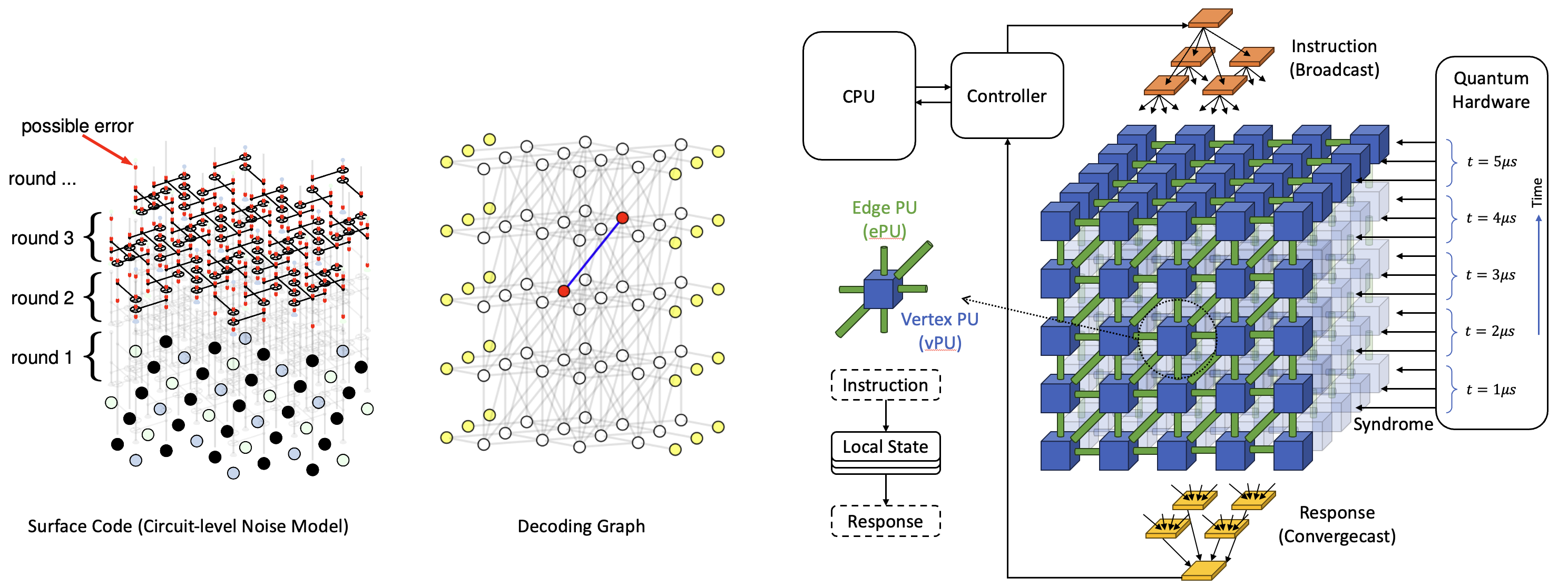

Exact decoding, hardware acceleration
The decoder retains the optimality of MWPM rather than replacing matching with an approximate heuristic. A parametrized accelerator handles massively parallel graph operations, while software handles more complex control and data structures. The implementation generates hardware for a supplied decoding graph.
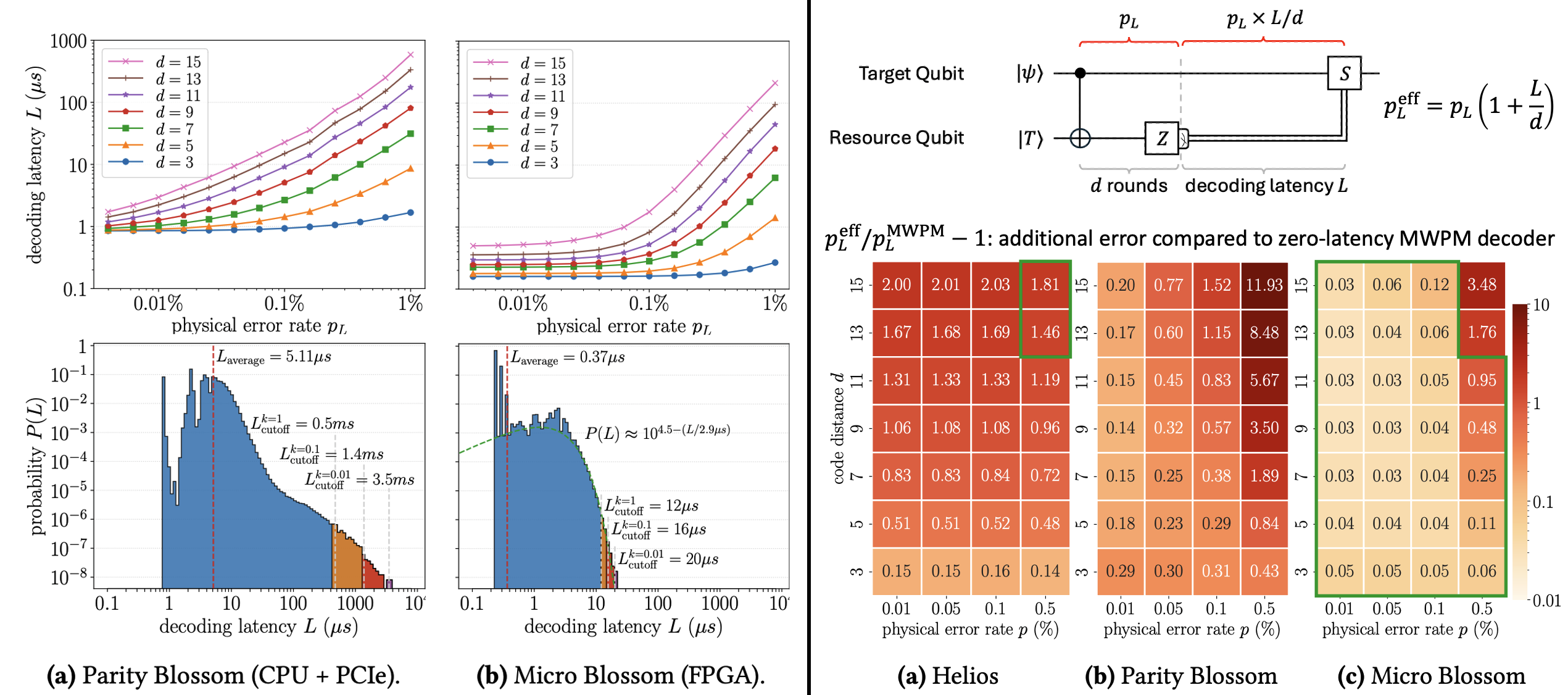

See the paper for the architecture, correctness arguments, and evaluation, and the open-source implementation for the hardware and software.

Yue Wu
Senior Researcher
I build algorithms, hardware, and systems for real-time quantum error correction at Microsoft Azure Quantum.