Hyper Blossom
From MWPM on graphs to MWPF on hypergraphs
Hyper Blossom (HyperBlossom in the paper) generalizes the blossom approach behind MWPM decoding from graphs to hypergraphs, making it applicable to general quantum low-density parity-check (qLDPC) codes and correlated error mechanisms.
A new graph problem for QEC
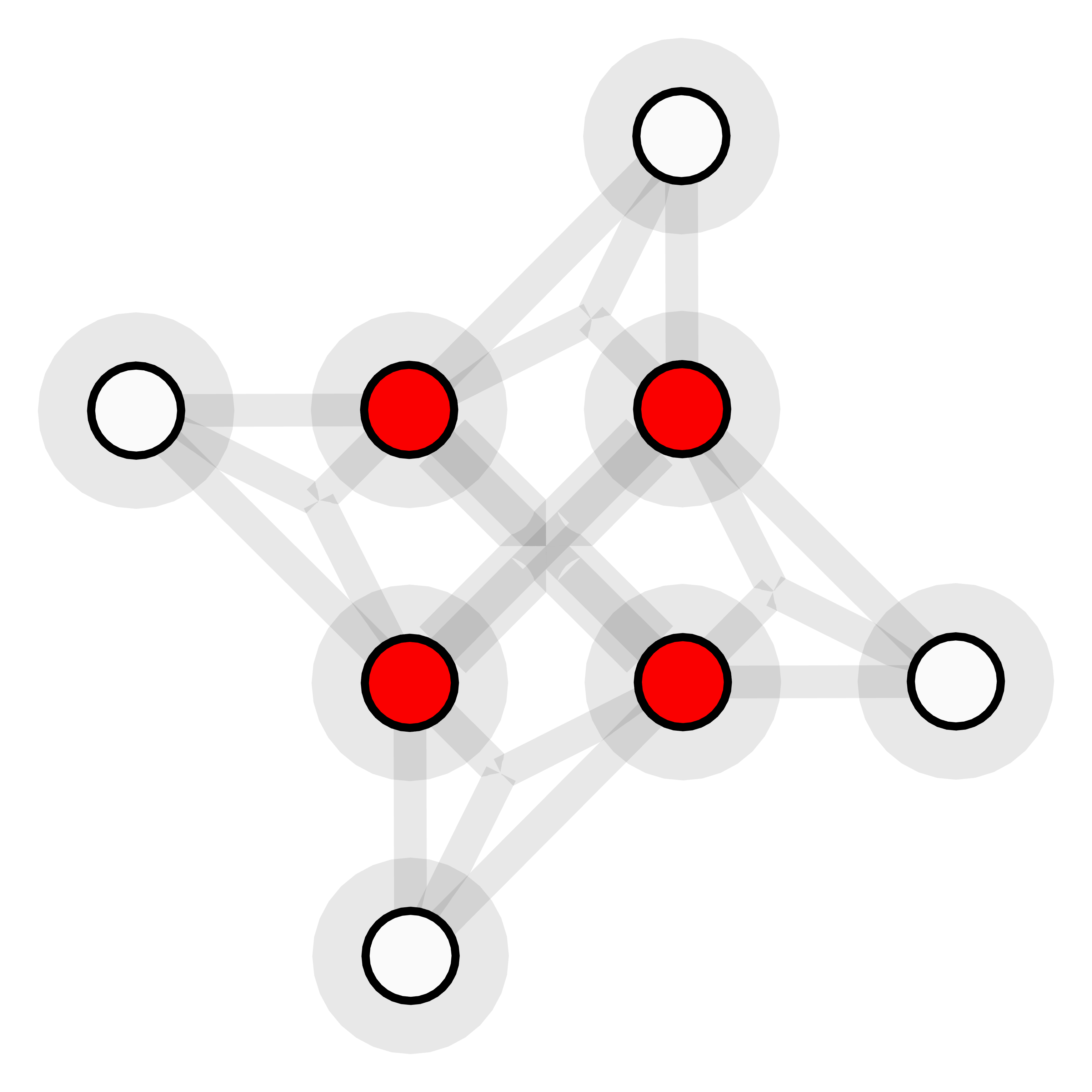
We formulate most-likely-error decoding as a minimum-weight parity factor (MWPF) problem: choose a minimum-weight set of hyperedges whose incident parities reproduce the measured syndrome. Unlike an ordinary decoding graph, a hypergraph can represent an error that triggers more than two detectors without splitting it into independent graph edges.
Mathematical guarantees, with explicit conditions
HyperBlossom uses a primal-dual linear-programming framework inspired by the blossom algorithm. The paper supplies mathematical proofs of optimality under stated conditions, as well as certifiable bounds on proximity to the optimum.
A feasible parity factor whose weight meets the dual lower bound is certified optimal; a remaining primal-dual gap bounds its suboptimality. General hypergraph MWPF is NP-hard, so these guarantees should not be confused with an unconditional claim of efficient exact decoding for every hypergraph.
Open-source implementation
Our implementation, Hyperion, is available in the MWPF repository, with a Rust core and Python bindings distributed as mwpf. Clustering targets almost-linear average runtime at low physical error rates.
Explore the interactive decoding demo or read the paper for the framework, proofs, and benchmarks.

Yue Wu
Senior Researcher
I build algorithms, hardware, and systems for real-time quantum error correction at Microsoft Azure Quantum.