Developed during my first year at Microsoft Azure Quantum, deq is the world's first general, universal, and dynamic quantum error correction decoding system. It connects declarative definitions of QEC codes and logical instructions to a runtime decoder for arbitrary dynamic logical circuits.
From LEGO proposal to deq implementation
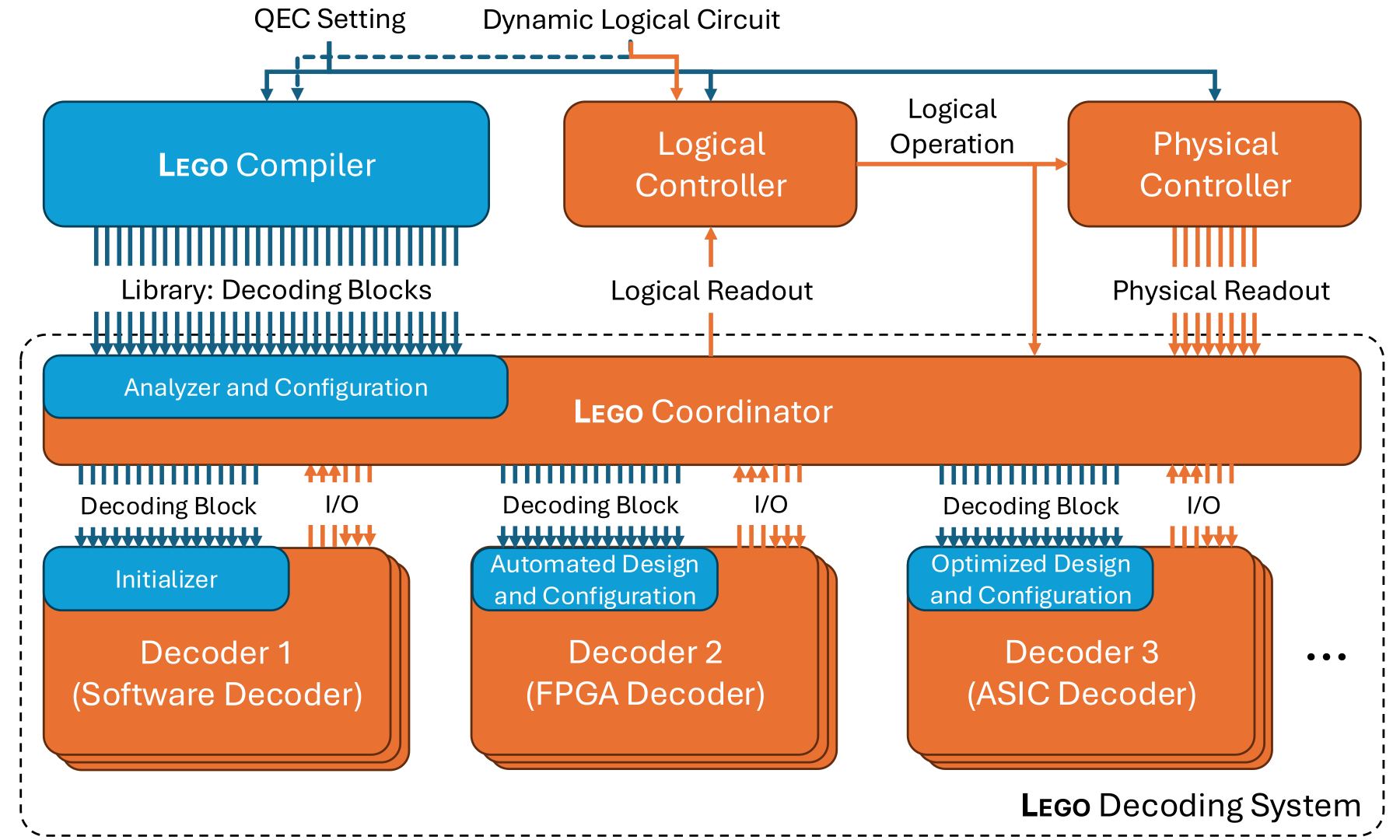
Our earlier paper, LEGO: QEC Decoding System Architecture for Dynamic Circuits, proposed a system architecture closely matching the design now implemented in deq. It separates offline compilation into a library of decoding blocks from an online coordinator that connects logical and physical controllers to decoder backends. deq is a working, open-source system, with a language, compiler, and runtime for dynamic QEC decoding.
Beyond a single decoding algorithm
Fast decoding of a fixed quantum memory is only part of the problem. A fault-tolerant computation changes its decoding problem as logical instructions execute, and measurement outcomes can determine which instruction runs next. deq automates the composition of these decoding problems rather than requiring an expert to hand-label an entire circuit.
- General: supports general QEC codes and custom logical instruction sets through a declarative language and compiler.
- Universal: supports the logical operations needed for fault-tolerant computation, including measurement-conditioned corrections.
- Dynamic: handles instructions arriving at runtime, feed-forward, and arbitrary branching rather than requiring the full logical circuit in advance.
- Modular: separates the system from its decoding algorithm, with built-in decoders and a stable interface for decoder plugins.
- Practical: provides a shared workflow for simulation, latency benchmarking, and hardware deployment.

Yue Wu
Senior Researcher
I build algorithms, hardware, and systems for real-time quantum error correction at Microsoft Azure Quantum.